Echium vulgare Identification - Summer 2016
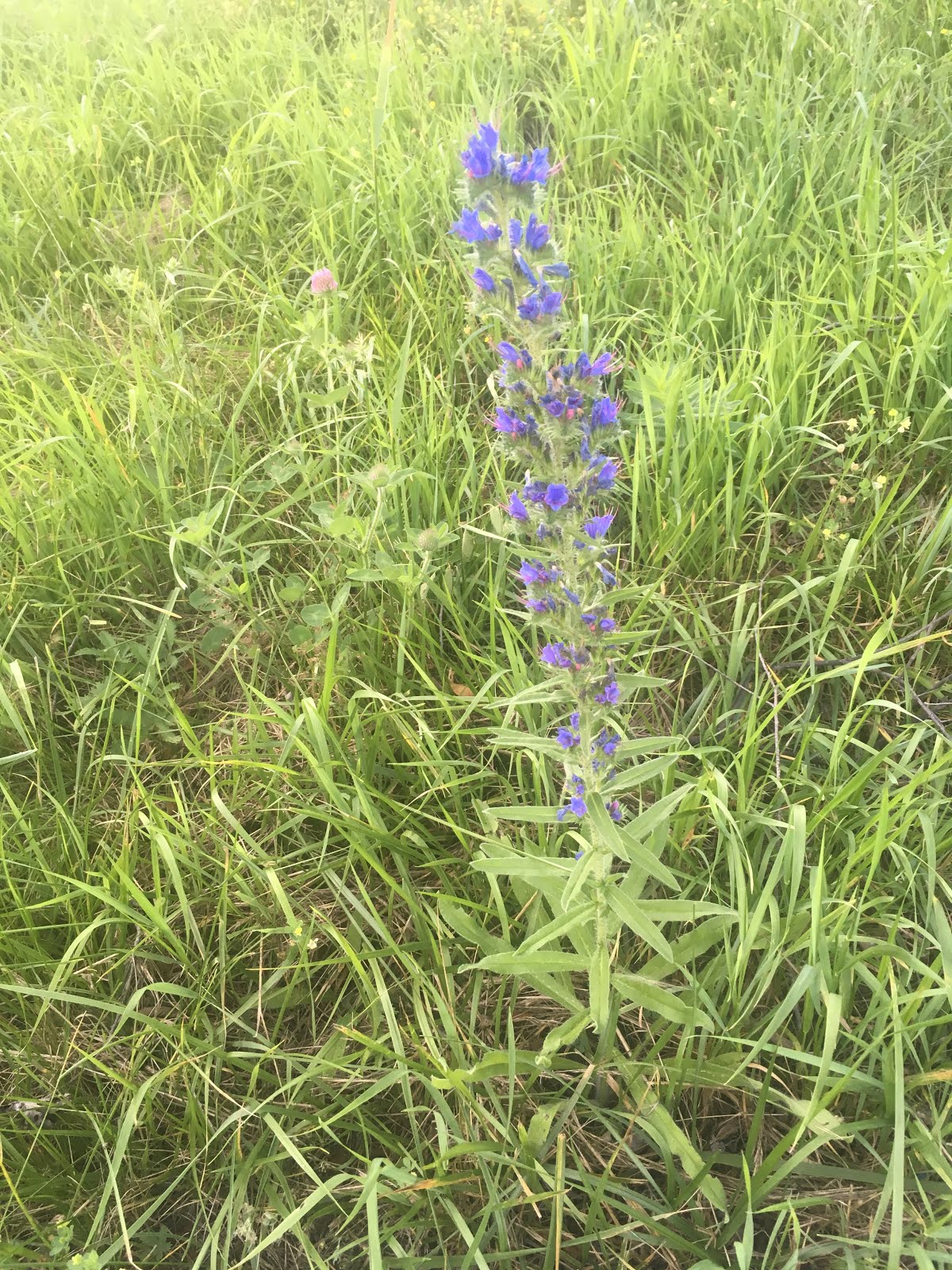
I saw a taller, blue flowered ‘spiked’ herb on the side of
the road. It looked too nice to be native in such density. I looked it up with
an internet search at first “Pennsylvania blue flower,” and with later success
with “blue flower spike.” I clicked the image, found a Latin name, and then
consulted identification guides and further internet searches.

Echium vulgare,
common name blue-weed (Gleason & Cronquest 2014), blueweed or viper’s
bugloss (Wikipedia 2016), or common viper’s bugloss (USDA-NRCS 2016) is in the
Boraginaceae or forget-me-not family. I thought to call it a spike as others
(Wikipedia 2016), but the literature identifies it as helicoid, bracteates
cymes (Gleason & Cronquest 2014), but others argue they are scorpioid (Buys
& Hilger 2003). This exotic is native to south Europe, but now common in
waste places, meadows, and as I found it in roadsides (Gleason & Cronquest
2014). It is found throughout much of the northeast U.S. down to Virginia, with
some records throughout the U.S., with a single county record of Cook County in
Georgia (Kartesz 2016 and USDA-NRCS 2016).

Identification was made by looking at pictures online. Then
I went to Gleason & Cronquest (2014) keying the plant out as herbaceous,
dicotyledons with perfect flowers [stamens (male) and carpels (female) in the
same flower], with both calyx (sepals – sub petal-like structures often
protects the flower bud) and corolla (petals, often the colored part) present,
with two or more ovaries in each flower (seed developing compartments, best
explanation I could do), and all this leads us to Section 12. From there 1
style for each flower, ovaries 4 and corolla gamopetalous (petals are joined
together) with 2-5 stamens; then leaves are alternate, stamens 5, and corolla
usually regular (but not in this case) we go the family Boraginaceae. Ovary deeply 4-parted, the style from between the
lobes; corolla with a well-developed tube; then corolla irregular with uneven
lobes; finally with stamens exsert (out of the corolla) that takes us to the
genus Echium. Within this genus,
there is only one choice, Echium vulgare.
Some features mentioned for this species: 4 filaments long-exsert, the 5th
not so much (male parts); style hairy (female parts); an erect tap rooted biennial
30-80 cm tall with bright blue flowers.

Although pictures were less complicated, the filaments of 4
long + 1 short, blue flowers, very hairy almost thistle-like but not as
harmful, with a stem that had brown speckles helped to confirm the plants were
the same. Also they mentioned the plant has blue pollen (Radenmaker and De Jong
et al. 1997)! I never thought of pollen other than yellow, maybe even orange or
white looking, but blue. Page 401 with an image of the plant in Holmgren (1998)
also helped.


I returned to the plants to view blue pollen. It appears
later in the season, these plants become highly infested with an insect, thus
losing their pleasant appearance. The pollen was not readily seen with the
naked eye, or a loupe of 10x magnification, or it was too late in the season.
It would be interesting to investigate later.


Buys, M. H. and H. H. Hilger (2003). "Boraginaceae
cymes are exclusively scorpioid and not helicoid." Taxon 52(4): 719-724.
Gleason, H. A. and A. Cronquist (2014). Manual of vascular
plants of Northeastern United States and Adjacent Canada. Bronx, NY, The New
York Botanical Garden Press.
Holmgren, N. H. (1998). Illustrated companion to Gleason and
Cronquist's manual Illustrations of the vascular plant of Northeastern United
States and adjacent Canada, The New York Botanical Garden.
Kartesz, J. T. (2015). The biota of North America program
(BONAP), Chapel Hill, NC.
Rademaker, M. C. J., T. J. DeJong, et al. (1997).
"Pollen dynamics of bumble-bee visitation on Echium vulgare."
Functional Ecology 11(5): 554-563.
USDA-NRCS (2016). The PLANTS Database, United States
Department of Agriculture, Natural Resources Conservation Service.
Wikipedia. 2016. Echium vulgare. Wikipedia. Retrieved June
2016, from https://en.wikipedia.org/wiki/Echium_vulgare


